
Why is thermocouple cable a critical part of temperature measurement?
A thermocouple measures temperature by using the thermoelectric voltage generated at the junction of two different metal alloys. The signal level is in millivolts. Therefore, the cable, connector, terminal and wiring method used from the sensor tip to the controller directly affect measurement accuracy.
Wrong cable selection can cause incorrect temperature indication, unstable process control, unnecessary energy consumption, quality problems and sensor failures. In industrial furnaces, plastics machinery, boilers, tanks, process lines and heat tracing systems, cable selection is as important as sensor selection.
Thermocouple cable, extension cable and compensation cable
Three terms are commonly used in thermocouple wiring: thermocouple cable, extension cable and compensation cable. Understanding the difference is essential to avoid measurement error.
| Cable Type | Description | Typical Use |
|---|---|---|
| Thermocouple cable | Made from thermocouple alloys and used as part of the temperature measurement circuit. | Sensor manufacturing, short field wiring and special applications |
| Extension cable | Made with alloys matching or very close to the related thermocouple type. | JX, KX, TX, NX extension cables |
| Compensation cable | Uses alternative alloys that simulate the thermocouple characteristic within a defined temperature range. | Economical long-distance wiring and panel-to-field signal transmission |
The key rule is simple: use K-type cable for K-type thermocouples, J-type cable for J-type thermocouples and so on. Using a mismatched cable creates unwanted thermoelectric voltage in the circuit.
Cable selection according to thermocouple type
| Thermocouple Type | Cable Code | General Application | Key Note |
|---|---|---|---|
| K Type | KX / KCA / KCB | General industry, furnaces, plastics machinery | Common in high-temperature and oxidizing atmospheres. |
| J Type | JX | Machinery, molds, low/medium temperature processes | Iron conductor requires attention in humid and oxidizing environments. |
| T Type | TX | Low temperature and precision measurement | Preferred for cold lines and sensitive measurements. |
| N Type | NX | High temperature processes requiring long-term stability | Can be more stable than K type in some applications. |
| S / R / B Type | SC / RC / BC | High temperature furnace and laboratory applications | Correct compensation cable is critical for noble metal thermocouples. |
How to select insulation material
Cable insulation is selected not only for electrical isolation but also for resistance to temperature, mechanical stress, oil, moisture, chemicals and flexibility requirements.
| Insulation Type | Advantage | Application |
|---|---|---|
| PVC | Economical, flexible, general purpose | Panel wiring and low-temperature field connections |
| Silicone | Flexible, heat and bending resistant | Machine wiring and vibrating areas |
| PTFE / Teflon | Chemical resistance and high insulation performance | Chemical processes, humid environments, precision lines |
| Fiberglass | High temperature resistance | Furnace surroundings and hot surface areas |
| Metal braid | Mechanical protection against abrasion and impact | Industrial field installations |
| Shielded cable | Protection against electromagnetic noise | Motor drives, SCR/SSR panels and long cable runs |
Shielding, grounding and electromagnetic noise
Because thermocouple signals are low-level signals, electrical panels, contactors, motor drives, SCR power controllers and high-current cables may affect the measurement. Shielded thermocouple cable is recommended for long distances and noisy environments.
- Route thermocouple cables separately from power cables.
- Use shielded cable when required and ground the shield correctly.
- Keep thermocouple signals away from contactors and power bars inside the panel.
- Minimize cable joints; when required, use proper thermocouple connectors.
Wiring mistakes and measurement errors
The most common errors are reversed polarity, wrong cable type, extension with copper cable, loose terminals, incorrect connectors and insulation not suitable for the service temperature.
| Error | Result | Solution |
|---|---|---|
| Wrong compensation cable | Fixed or variable measurement deviation | Use cable matching the thermocouple type. |
| Reversed polarity | Temperature may decrease when actual temperature rises. | Check positive/negative legs and instrument input. |
| Copper cable extension | Cold junction error and measurement deviation | Carry the signal with thermocouple or compensation cable. |
| Loose connection | Unstable readings and signal fluctuation | Tighten terminals, plugs and cable ends. |
| Incorrect insulation | Deformation, short circuit or insulation failure | Select insulation according to ambient temperature and chemical conditions. |
Color codes and field installation
Thermocouple cable color codes may vary by country standard and manufacturer. Therefore, wiring should not rely only on colors. Always verify the cable marking, manufacturer datasheet and instrument input type.
During maintenance, the old cable and new cable may use different color codes. In critical processes, measurement verification after cable replacement is recommended using a reference calibrator, ice bath or process comparison.
Thermocouple cable selection checklist
- Thermocouple type: J, K, T, N, S, R or B?
- Cable type: extension or compensation?
- Ambient temperature and maximum cable exposure temperature?
- Mechanical abrasion, oil, moisture or chemical contact?
- Electromagnetic noise risk?
- Cable length and shielding requirement?
- Termination style: free end, mini connector, standard connector, panel socket or head connection?
- Is redundancy or signal monitoring required for machine/process safety?
TEMPCO thermocouple cable and compensation cable solutions
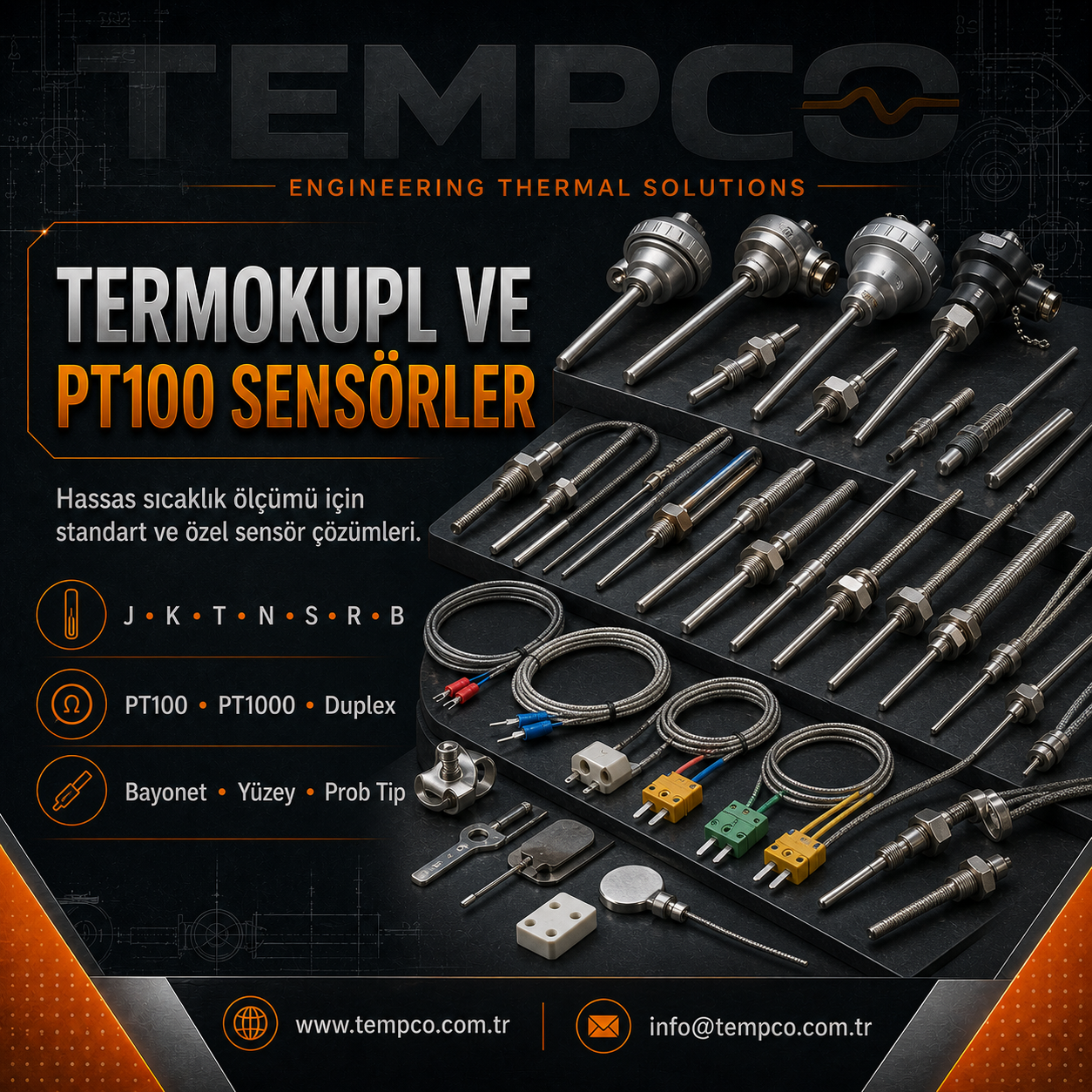
TEMPCO supplies thermocouples, RTD sensors, compensation cables, thermocouple connectors, connection heads, thermowells and temperature measurement accessories. The correct cable construction is selected by evaluating process temperature, cable route, instrument type and environmental conditions.
For quotation, please share thermocouple type, cable length, insulation preference, termination style, operating temperature and quantity.
Frequently Asked Questions
Can ordinary copper cable be used instead of thermocouple cable?
The thermocouple signal must be carried by thermocouple or proper compensation cable up to the measuring instrument. Copper cable may be used only after a transmitter output such as 4-20 mA.
What is the most important criterion when selecting compensation cable?
The most important criterion is compatibility with the thermocouple type. Use K-type cable for K-type thermocouples, J-type cable for J-type thermocouples and so on.
Is shielded thermocouple cable always required?
Not always. However, it is recommended for long cable runs and electrically noisy environments such as motor drives, SCR/SSR panels and high-current wiring routes.
How long can a thermocouple cable be?
The practical length depends on cable type, electrical noise, instrument input and required accuracy. For long distances, shielded cable, proper routing and field transmitters may be considered.